

Documentary animation: how animation tells history, from lead to AI
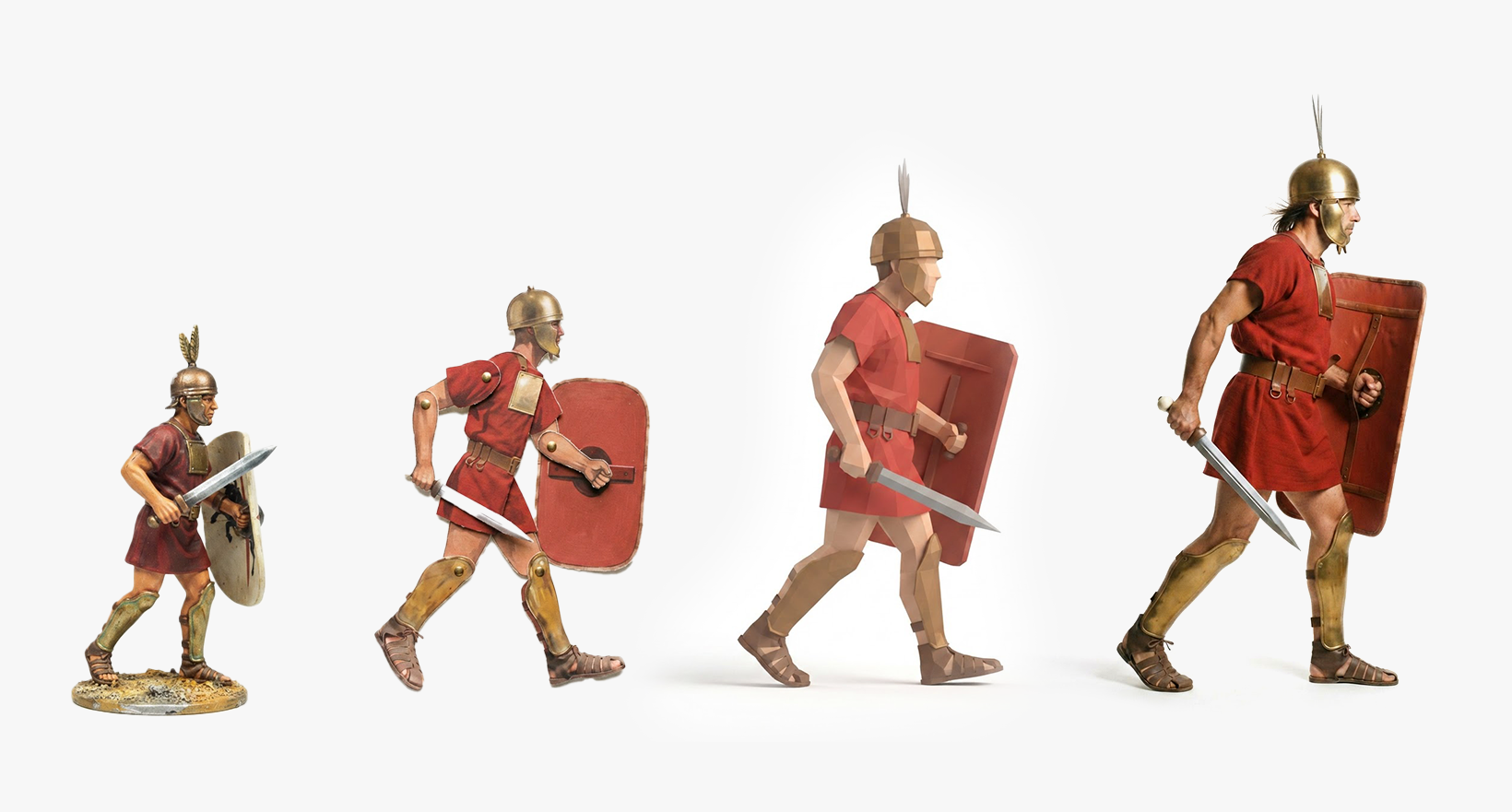
Documentary fiction is a reconstruction technique that blends the rigor of a documentary—verified facts, precise historical context—with the creative freedom of animation to bring events or places that no longer exist to life. It allows us to show what no camera could ever capture: an ancient battle, a vanished port, or a scene from the past.
The challenge has never changed: to immerse someone in a historical context credibly, without ever having access to the real thing to film. What has changed, however, are the tools used to achieve it.
Figurines and paper cutouts
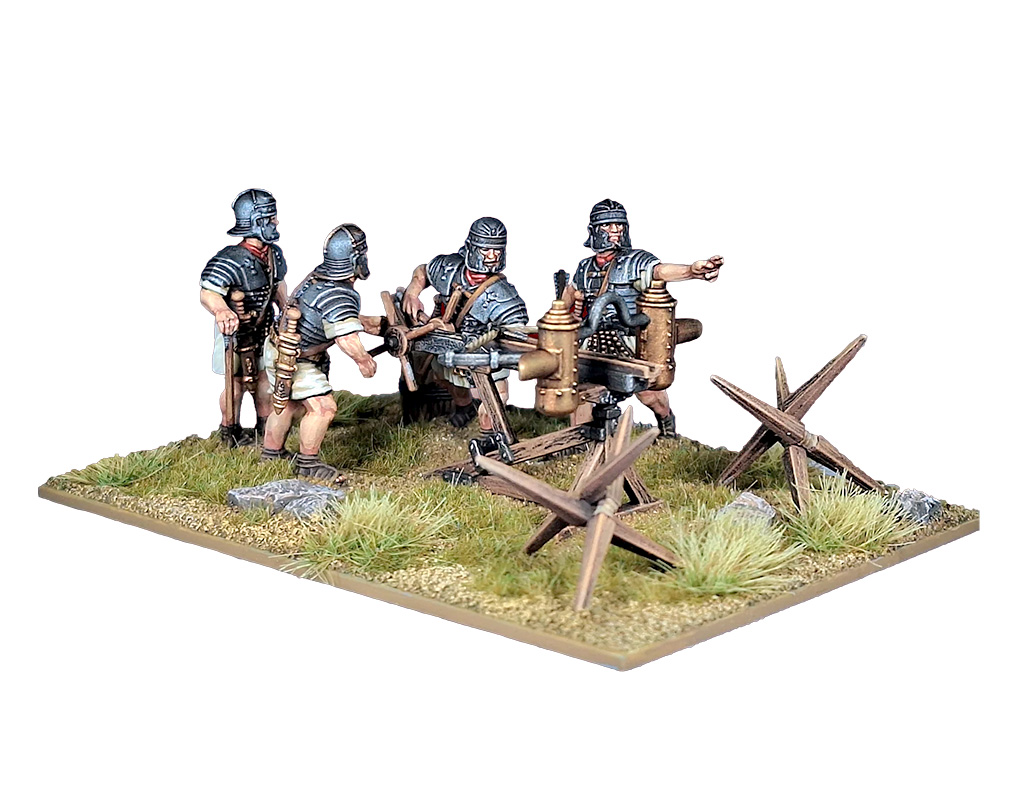
Before the digital age, reconstruction relied on physical objects: hand-painted lead figurines or paper cutout puppets animated frame-by-frame in front of a camera. Even before the digital era, this principle was rooted in puppet shows and shadow theater, both of which are early forms of narrative expression.
It possesses a rare quality: the handmade aspect is visible, and this imperfection provides a texture and grain that no digital technique can truly replicate.
The shift to digital
Digital technology initially replicated what existed in the physical world. Digital paper cutouts emerged as the dematerialized version of puppets: flat, articulated shapes animated on screen rather than in front of a camera. Entire software suites specialized in this approach, allowing for faster production than with physical objects without losing the characteristic graphic style of cutouts.
3D: more realism, more constraints
The arrival of 3D made it possible to push realism much further: volumes, lighting, textures, and a camera that can move freely through space. For historical reconstruction, this is a significant gain in immersion.
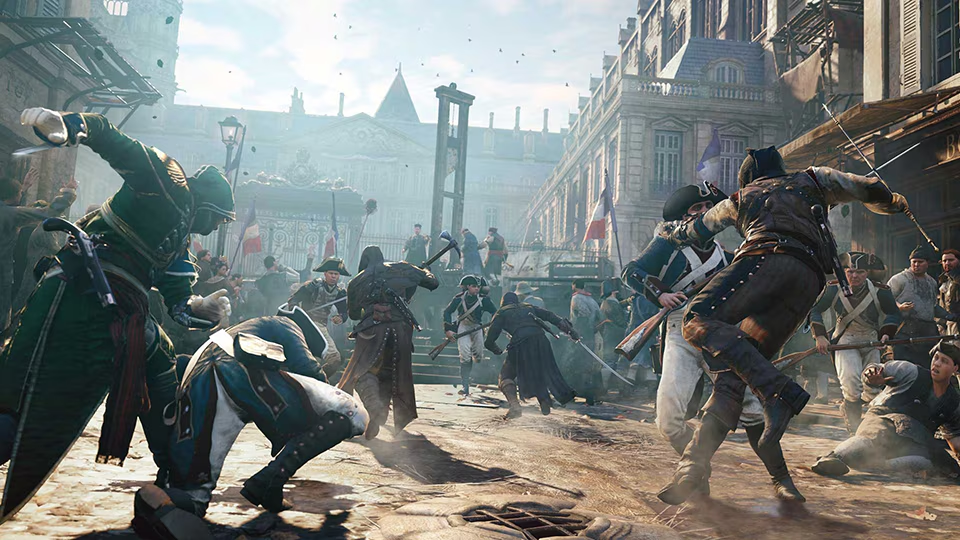
Above all, there is total control: dimensions, textures, and materials. You can go into great detail. Some historical reconstructions can be seen in video games, such as Assassin's Creed Unity, in which you can immerse yourself in Paris during the French Revolution.
The downside: 3D is time-consuming to set up. Modeling a set or a character to a credible level of detail takes time, requires specialized technical expertise, and can quickly become expensive, especially for a project that does not justify a long-term production.
AI video generation: the same goal, a different path
AI video generation aims for the same result as 3D, but with a different approach: often higher visual realism, achieved more quickly, without the need for manual modeling of every element.
It also has its own limitations. A lack of consistency from one shot to the next, some inaccuracies in rendering, and control that is harder to achieve than in 3D software where every parameter can be adjusted by hand. In reality, every technique has its flaws: 3D has its own, as do paper cutouts and lead figurines. Each has always required a compromise between realism, time, and budget.
What changes with AI is that realism is now accessible within a limited production timeframe.
The only criterion that matters: immersion
None of these techniques is inherently superior to the others. The choice depends on the project: the available budget, the desired style, and the level of realism needed for the story to work. A paper cutout puppet can tell a story just as powerfully as a photorealistic 3D scene, provided the style serves the narrative.
AI is neither a miracle solution nor a gimmick. It is one more tool in an environment that already contains many, all serving a single goal: telling a story in a credible way.
And right now...
Right now, many documentaries illustrated with AI-generated videos are emerging. The quality isn't always there, because this technique still requires time to make it look credible. It’s the same old story: don't mistake speed for haste.
Personally, I am currently working on a historical video reconstruction generated by AI. And I am amazed by its possibilities every single day. But to achieve a result that meets production standards, it is sometimes meticulous, painstaking work, and a single click is never enough. It requires patience, a lot of patience...
If you have a story to tell, an event or a place that deserves to be reconstructed, I would be happy to discuss it with you.

Alexandre Soubrier is a freelance motion designer with a passion for illustration and animation. He created the podcast Exquises Exquisses in which he interviews author-illustrators, and produces this blog.
Contact him here or on Linked In.


